
Behind The Scenes:
How It's Made
Everything begins with a drawing.
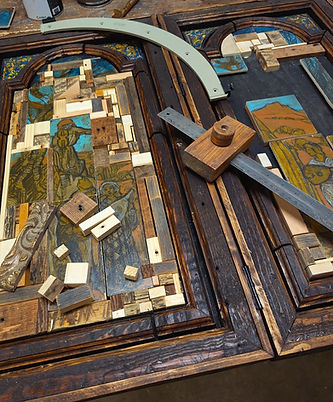
From there I break the image down into compartments: separating it into parts and slowly rebuilding it into, and within the wood.
That drawing becomes the map from which I separate the composition into sections that can be carved, developed or painted individually.
These sections give me a structure to work through – but they also create space for the material to speak back and influence the direction of the piece.
Rooted in Alberta History:
Recycled Wood from old Grain Silos
Most of the boards I work with are reclaimed. They’re weathered, marked by time, use, and exposure.
They carry knots, cracks, stains, saw marks, and scars from the life they lived before they reached my table.
I spend time with these marks. They tell me where to begin, and influence how the work progresses.


My work starts as something else: century old, dilapidated grain silos from the Alberta prairies – considered obsolete and unusable.
As I cut into the panel, the grain, knots, cracks, and old saw marks begin to redirect my decisions.
A line shifts to follow the grain.
A shape opens where the wood has split.
A figure adapts to a scar already present in the surface.
By the end, the drawing is no longer just a drawing. It has been absorbed into the material – part painting, part print, part wood – carrying both my hand and the history of the surface itself.


The Art of Collage: Mixed Media Artwork
When I begin to develop an idea, it usually starts in one of three forms: a tone, a concept, or a shape.
The shape compositions are, to me, always the most engaging, and develop into the most interesting journeys.
At times the shapes emerge naturally within the structure itself. I have to be mindful of how visually busy the surface can become. Too much activity can create confusion and distract from the overall reading of the piece.
The process is an organic ebb and flow of form influencing process, and process influencing form. I adjust the tone, concept, or shape to bring clarity back into focus.
It’s a continual balancing act that unfolds throughout each work’s development: a quiet negotiation between complexity and restraint.
A Dance of Art and Texture
Inspired by Renaissance Frescoes and Structures
I rotate, shift, and reorganize each fragment until a new structure emerges.
Instead of hiding imperfections, I follow them.
Grain becomes line.
Cracks become boundaries.
Seams become a part of the composition.
What interests me is not what the material once was: but what it can become. The wood is not just a canvas on which the image is applied – it is built into it.
The work exists somewhere between painting, crafting and sculpture, a piece discovered as much as created.
